
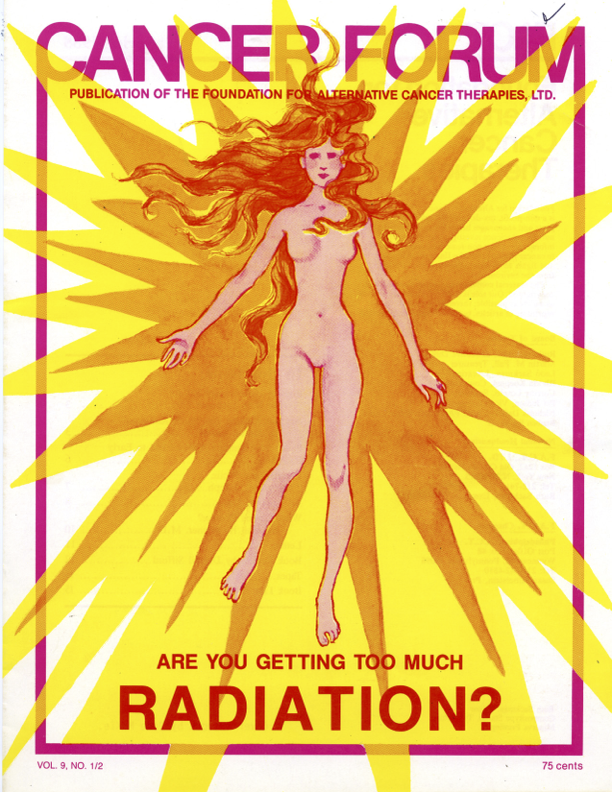
“Every exposure to these particles damages living tissue and the effects are cumulative. Now, discover why even your color TV could be wrecking your health…
Shivering and half-naked, you are brought into a room containing a gigantic ray gun and what appears to be an executioner’s worktable. The torturer puts you on his block, arranges your helpless body in a grotesque pose, brings the head of the ray gun mere centimeters from your flesh, says, “Don’t move!” and then runs out of the room. He cowers behind a lead insulated barricade and throws the switch.
A nightmare? No, just an X ray although for many, the two aren’t so different, You, of course, imagine you are frying to death and are quite surprised, once the ordeal is over, to find you’re alive and intact. Still, you worry: Is something awful going to happen to me later on because of this radiation?
You are right to worry. The brief history of manmade radioactivity is packed with disaster. The co-discoverer of radium, Marie Curie, died in 1934 of what doctors now recognize as radiation-induced leukemia. Husband Pierre probably would have suffered a similar fate had he not been run over and killed by a horse and cart first.
Appreciation of the dangers of radiation has come only gradually. Fifty years ago, dentists would hold X-ray film with their fingers while they photographed the jaws of their patients. Unaware that the same dose of radiation that was harmless (they thought) to the patient could be lethal when administered many times daily over a period of years, quite a few of these practitioners ended up with skin or bone cancer that began as lesions on their fingers. Forty years ago, a chain of children’s shoe stores used fluoroscopes to check the fit of their shoes and many of the clerics lost fingers, kneecaps, and gonads to radiation.
Thirty years ago, X-ray therapy was thought to be an excellent treatment for enlarged adenoids and tonsils; children were exposed to horrifying dosages. During the same period, chest X rays were being given free to check for tuberculosis and lung cancer; no one knew that radiation could cause cancer.
Today, we know that no radiation is safe. Every exposure to radioactivity, however mild, does permanent damage to living tissue. “Theoretically, even the smallest amount of radiation could contribute to cancer induction,” says George Casarett, a member of the Nuclear Regulatory Commission. The effect of radiation is cumulative. Tiny amounts taken in year after year can eventually become dangerous. And radiation damage, including radiation-induced tumors, sometimes takes decades to show up.
Even natural radiation cosmic rays from outer space, radioactivity from elements in the earth can be harmful. Cosmic-ray exposure increases at high altitudes, where the atmosphere is thinner; if you live in Denver (one mile above sea level), your exposure will be almost twice that of someone who lives in New York City (sea level). Residents of Kerala, India, where the earth contains radioactive thorium, get almost ten times more background radiation than the people in Lancaster, Pennsylvania. And dwellings made of stone, concrete, or masonry are apt to have more background radiation than those made of wood. This applies to cities as well. New York, almost entirely concrete, has more radiation than Los Angeles, which is constructed like a giant suburb.
HOW WORRIED SHOULD I BE?
The younger you are, the more you should be concerned about radiation. As we’ve seen, the effects of radiation are cumulative and slow to appear. If you’re a parent and the doctor wants to X-ray your child, you should refuse unless it is urgently necessary. If you’re in your teens or twenties, resist any X ray not of vital importance. Older people can be less stringent, because the cumulative dangers are less severe.
Also, learn a lesson from history worry a little bit more about radiation than your doctor tells you to. You simply can’t be sure that today’s acceptable level of exposure will be considered equally acceptable in the future.
Look, for instance, at the history of the mammogram, used to detect cancerous tissue in the breast. The test is not perfect: It has a 6 percent false negative rate (meaning that six times out of a hundred it does not find a cancer that is actually present) and an 11 percent false-positive rate (diagnosing cancer when the woman does not have it). Nevertheless, when mammography was first developed, it was hailed as an effective screening device for detecting early cancer. Mammograms were recommended as a test for all women thirty-five and older.
Mammography has saved many lives by detecting early cancers, but it uses relatively large amounts of radiation to find them, and, therefore, can cause the disease. In 1976, a prominent medical researcher, John D. Bailar, released a study in which he “regretfully” concluded that the routine use of mammographs to detect cancer probably causes as many deaths as it prevents! The National Cancer Institute has, since 1977, revised its guidelines, advising regular mammograms starting, generally, not until age fifty; starting at forty for women with a family history of breast cancer, and at thirty-five for those with a personal history of the disease.
WHAT IF I REALLY NEED AN X RAY?
Sometimes, of course, X rays are vitally important. You wouldn’t want a doctor treating a fractured skull, pelvis, or limb to proceed in the dark, without a precise picture of what the bones look like. Similarly, if lung, breast, or uterine cancer is suspected, you would certainly want the doctor to have X-ray film of the organ in question.
If you must be X-rayed, determine who is going to take it, where, and on what equipment. Much X-ray equipment is antiquated or defective or set to deliver too much radiation. A 1975 report by the Department of Health, Education, and Welfare found that the dose of radiation delivered by dental X rays ranges from 100 to 5,000 millirads: the average is 1 rad which is over three times the necessary exposure. Mammograms range from as low as 300 millirads to as high as 3,000.
The situation is improving. More and more doctors and hospitals are having their X-ray equipment checked and readjusted to deliver the least possible radiation. Dental X-ray technique has been spruced up, too, thanks to a monumental Food and Drug Administration project, DENT (Dental Exposure Normalization Technique), in which most dental X-ray units in the country were tested and the personnel operating them were shown how to get pictures with minimum radiation. Since DENT, the average radiation dose has dropped 38 percent.
Finally, a new and virtually harmless X-ray system is now in experimental use at some of our major hospitals. In this new technique, called microdose digital radiography, a low-intensity X-ray beam scans a part of the body; a computer then produces a picture. The beam is so well focused that there is little or no scattering, and thus no need to shield either the patient or the operator of the machine. To produce a chest X ray, only about 1 millirad is required, as opposed to 20 to 75 by the conventional method.
BEFORE YOU’RE X-RAYED
Here are some tips to follow if you’re told to have an X ray:
Ask, “Is this X ray necessary?” In many cases, it isn’t. Some clinics instruct the admitting nurse or intern to order X rays for all incoming patients. Insist on talking to your doctor first. If he agrees with hospital rules, ask again if it’s vital to your case. Many X rays are given for reasons other than the welfare of the patient in order to have convincing insurance documentation, for instance, or because the doctor wants to have complete before-and-after shots to round out his files, or because yours is a medically fascinating case. If the explanation sounds weak, don’t acquiesce just to be polite say no, even if that means having to find another physician. Look at his machine. Ask how long he has had it. X-ray machines built before 1974 emit more radiation than the improved models designed later. If the machine looks old, ask to have your X rays taken somewhere else.
Ask if he knows how much radiation his unit delivers. Not many doctors or dentists have this information; usually a trained radiation physicist must compute the actual dose being given. If her machine has been checked in this manner, your doctor should be able to tell you how much radiation it delivers. If not, she should be willing to tell you what she does know about her equipment. If she seems unsure whether her equipment is low-dosage or semi-lethal, do not allow her to X-ray.
Keep a record of your X rays. Write down the exact medical or dental description of each X ray, date taken, name of doctor who ordered it, and address where it is on file. When a doctor asks for an X ray, show him your record. He may be able to use a film you had taken last year. Even if your old X rays are out of date, the doctor may want to see them to judge the progress of your condition.
Never suggest an X ray. Don’t even ask, “Am I going to need an X ray?” You’ll probably give your doctor the idea that you want to be X-rayed, and she’ll be happy to oblige.
X-RAY CHECKLIST
Remember these rules about the X rays you’re most likely to need:
- Chest X ray. Although this procedure uses relatively little radiation, annual chest X rays are not recommended. Have one only when your doctor says it’s needed; if you’ve been smoking for fifteen years or more, a chest X ray every two or three years might be wise.
- Dental X rays. These should be taken only when needed not at every six-month checkup. One set of films will last a conservative dentist for years. Only if she thinks changes have occurred should she want to redo them.
- Mammograms. Breast X rays should never be part of a routine exam except for women over fifty and younger women with a history of cancer. Women thirty-five to forty are encouraged to have one mammogram to be used as a comparison when and if further mammography is done later.
- Fractured arm or leg. An X ray here is essential to allow the doctor to set the bones properly. After the break is healed, your orthopedist may want to take another shot or set of shots to see how well the bones are aligned. This is more for his edification than yours; you can refuse if you’re satisfied your limb is well again.
- Protective shields. No matter how well focused a conventional X ray may be, there is always some scattering of the rays. When getting dental X rays, you should be given a lead apron or collar to shield the thyroid gland and other organs from any spillover. In other types of X ray, you may need a gonadal shield to protect the reproductive organs. If these shields are not offered, ask for them.
- X rays during pregnancy. At this time, no X rays should be taken, especially in early pregnancy when the fetus is most vulnerable. This early period is so important that you should refuse X rays if you even suspect you might be pregnant, unless you have serious symptoms that demand investigation. Even then, ask whether the X ray can be postponed until after the baby’s birth. If not, demand to know what steps can be taken to minimize the fetus’s exposure to radiation.
X rays can be tremendously useful to your well-being and survival, so when one is needed, don’t be afraid. Ask questions and if you’re satisfied with the answers, accept the X ray with the confidence that you’re doing something right for your health.
Editor’s Note: X rays to the fetus can cause leukemia.
Reprinted with permission from Cosmopolitan Magazine.

